At 51, I'd Become a Stranger in My Own House. Everyone Said It Was Just Age.
It wasn't. 90 days and three blood panels found the hormone starving my strength, my drive, and the man my family lost — and the one thing that brought him back. No TRT. No needles.
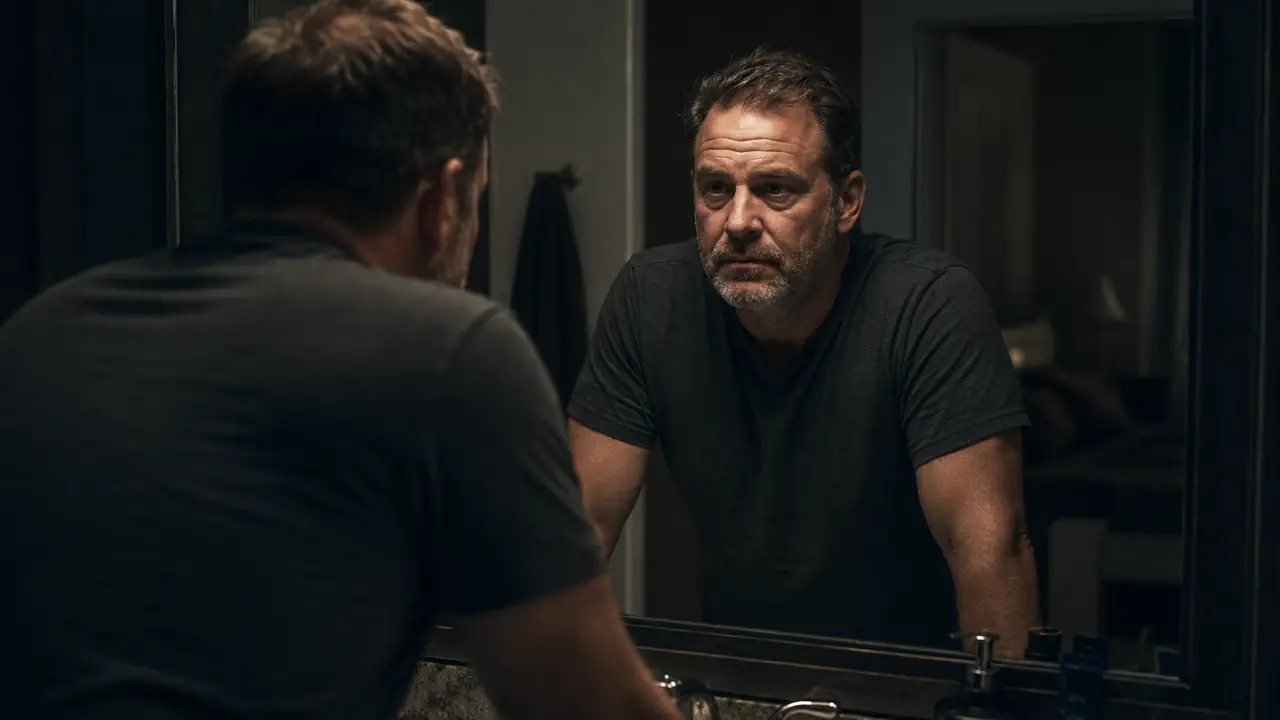
My son asked my wife — not me, her — if I was okay. He was fifteen. He'd walked past the couch where I'd fallen asleep at 8:14pm again, remote still in my hand, and he asked her in the kitchen, quietly, like I was already gone.
That's the sentence that put me in a lab the next week. Not a symptom. A sentence.
- Total testosterone: 372 ng/dL
- Free testosterone: 6.8 pg/mL
- Cortisol (AM): 24.6 mcg/dL HIGH
- Estradiol: 36 pg/mL HIGH
My doctor looked at 372 and said the same thing every man my age hears: "That's within range. It's normal for 51." Normal. As if the man who used to coach my son's team, who used to want things, had just been quietly filed under "aging" without anyone checking what was actually eating him.
But I didn't need a chart to know something was wrong. I'd known for two years. I just didn't have a name for it — or a number.
It Didn't Happen Overnight. That's Why Nobody Caught It.

There was no single bad day. That's the cruel part. It came in inches. The alarm got harder to beat. The gym became "next week." The gut showed up and wouldn't leave no matter what I cut. I started snapping at my wife over dishwasher loading — dishwasher loading — then hating myself for it in the same breath.
The drive just… drained. Not only in the bedroom — for everything. Projects I used to chase felt like weight. I'd sit in meetings I once ran and feel the words leave my head halfway through a sentence. By 8pm I was done. Karen stopped making evening plans that included me. She didn't say why. She didn't have to.
Every man in my life had the same diagnosis: "Welcome to your fifties." My buddies. My own father. Even the first doctor. So I did what men do — I tried to tough it out. Push through. Man up. And I got quietly, steadily worse, blaming a birthday.
So I did the one thing tough guys are terrible at. I stopped guessing and I measured. Three weeks reading endocrinology papers instead of sleeping. And what I found didn't make me feel old. It made me furious — at how many men are handed a birthday as a diagnosis while the real thief walks free.
Meet the Cannibal Hormone.
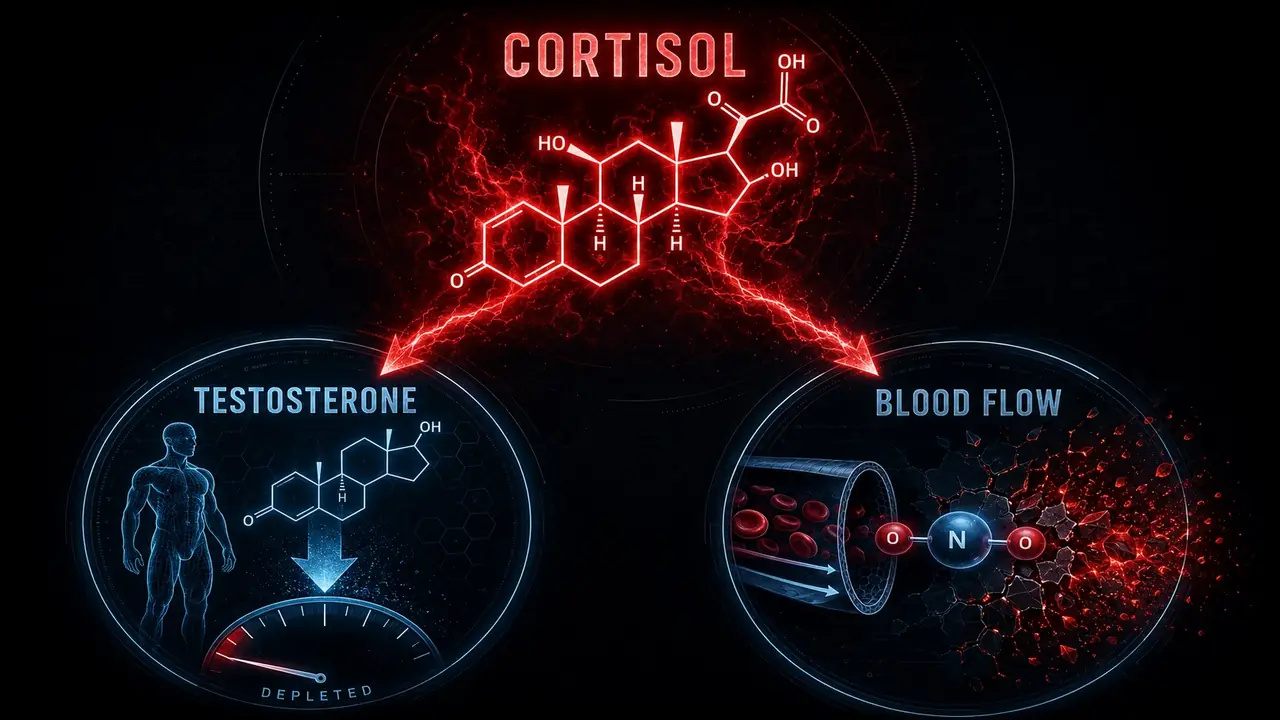
Here's what no one told me. Testosterone doesn't just "decline with age." After 40, under relentless modern stress, one hormone turns on your own body and starts eating it from the inside. Its name is cortisol — and I started calling it the cannibal.
Cortisol and testosterone are built from the exact same raw material: pregnenolone. When stress keeps cortisol jacked around the clock, your body pours the entire supply into cortisol and leaves almost nothing to build testosterone. That's the theft. But it doesn't stop at stealing — it consumes. It degrades the tissue in the very organs that make you a man:
That's why a single-ingredient booster from the vitamin aisle is a waste of sixty bucks. You can't out-supplement being eaten alive with one isolated compound. And that's why TRT scared me: flooding in outside testosterone while the cannibal is still active doesn't rebuild you — it shuts down what little natural production you have left, and hands the estrogen machine more to convert.
The Thing That Rebuilds the Organ Itself.

I'd built a spreadsheet — eight supplements, a hundred and eighty bucks a month, twelve pills a day. Then a thread on r/Testosterone stopped me cold. A guy had laid out the exact cannibal mechanism I'd spent three weeks reconstructing. But he wasn't stacking pills. He'd gone back to what every strong generation before ours understood and we threw away: you rebuild an organ by feeding the body that organ.
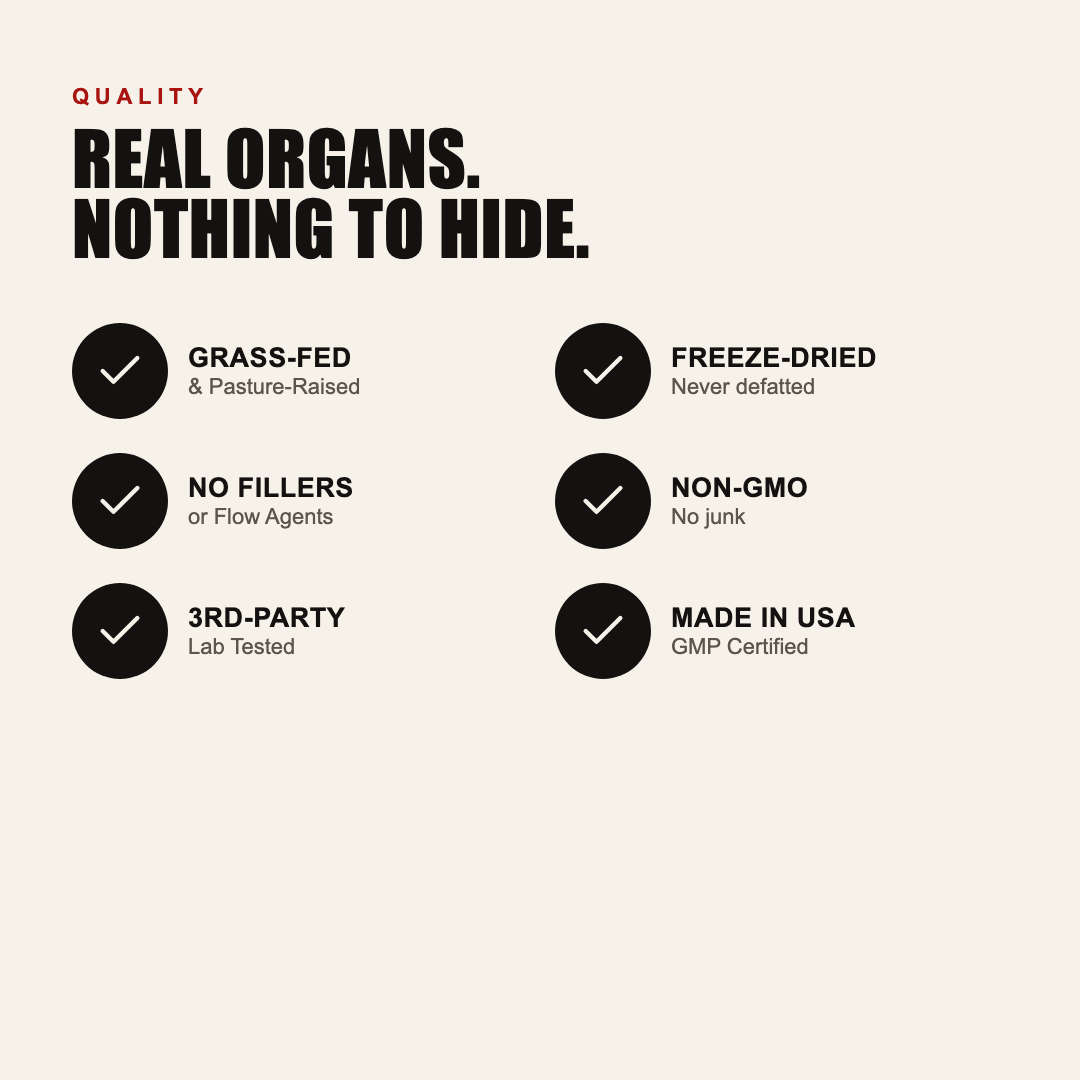
Not an isolated extract. The real tissue — testicle, adrenal, heart, liver — freeze-dried, grass-fed, the way our great-grandfathers ate the whole animal instead of just the muscle. He posted his panels. Total testosterone up 68%. Cortisol down a third. And the way he described getting his drive back — not just energy, the want — was the first thing in two years that sounded like me.
The product was called Badrock. A beef-organ complex, built for exactly this. I ordered that night, started the next morning, and tracked every day.
90 Days. Two Capsules. The Man Came Back.
The Couch Lost Its Grip

Day 4, the 2pm wall didn't hit. Day 6, I made it to 10pm awake — actually awake, not staring. Day 7 I woke before the alarm and, for no reason, made eggs for my son before school. He looked at me like I'd grown a second head. Small. But I wrote it down.
The Drive Came Back Before Anything Else

This is the part I can't fully explain. It wasn't just energy — it was wanting things again. I opened a project I'd been avoiding for months and just… did it. I caught myself making a plan for the weekend. Karen noticed before I said a word. "You seem like you," she said at dinner. Then, quieter: "I missed him."
The snapping stopped. Not because I was trying. Because the thing underneath it had let go.
From 372 to 655. The Panel Didn't Lie.
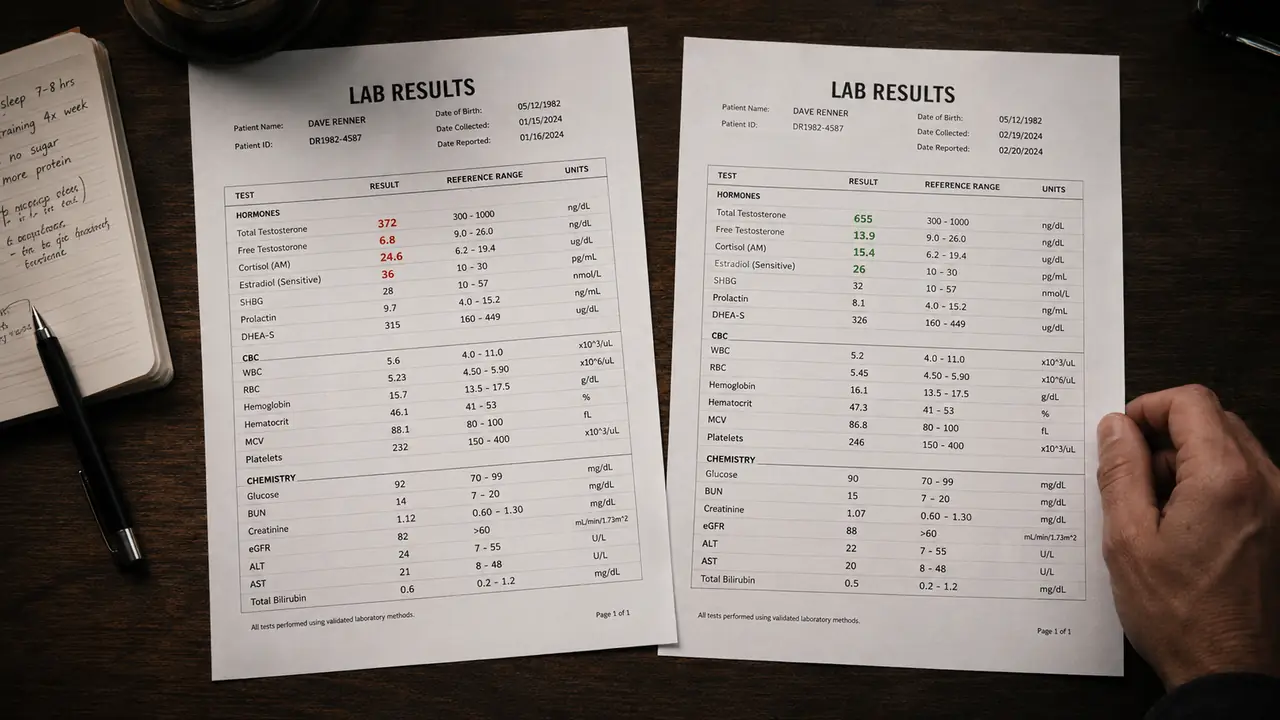
Same lab. Same time of morning. I opened the envelope in the parking lot — same spot I'd read the first one.
Every marker moved. The cortisol drop meant the theft had stopped. The testosterone nearly doubled because my own factory was running again — not because I'd injected anything. This wasn't a stimulant spiking a number for an afternoon. It was tissue being rebuilt.
The Gym. The Gut. The Guy in the Mirror.

Recovery time cut in half. Weight going back on the bar. The gut that four years of dieting couldn't touch started shrinking — and I hadn't changed how I ate, only what was finally processing the fat instead of storing it. My son asked me to throw a ball. I didn't have to fake having the energy. That one nearly got me.
The Numbers Held. So Did the Man.

Third panel. Testosterone above 640 and steady. Cortisol low and stable. Not a spike that crashes — a repair that held. But the number I care about isn't on the panel. It's that my kid stopped asking his mother if I was okay. He just asks me stuff now. Like I'm here.
What I'd Tell Any Man They Called "Old."
If a friend told me what I lived — 51, exhausted, flat, snapping, doctor says "normal for your age" — here's what I'd say. Don't accept a birthday as a diagnosis. Don't inject outside testosterone while the cannibal is still eating, and shut your own factory down for good. And don't waste another sixty dollars on one isolated ingredient trying to patch a whole-body collapse.
Feed the organs the cannibal is starving. That's the whole thing. My panel changed. My energy changed. The man my family lost came back. Yours can too — and a blood test won't let you lie to yourself about it either way.
For twenty years I've watched men handed the word 'normal' at a testosterone of 370 while their whole physiology quietly comes apart. What most doctors miss is the cortisol driving it — the same hormone that steals testosterone also degrades the tissue that makes it. An organ-based protocol is the first natural approach I've reviewed that feeds that tissue directly instead of forcing one pathway with a stimulant or overriding it with a needle. It maps to the actual endocrinology.


1 Bottle
30 Day Supply



- Auto-delivery every 30 days
- 90-Day Money-Back Guarantee
- Cancel anytime
supply
3 Bottles
90 Day Supply
- Auto-delivery every 90 days
- Free shipping
- 90-Day Money-Back Guarantee
- Cancel anytime
supply
2 Bottles
60 Day Supply
- Auto-delivery every 60 days
- Free shipping
- 90-Day Money-Back Guarantee
- Cancel anytime
supply
The Bloodwork Guarantee
Run it for 90 days. Pull a testosterone panel. If your numbers haven't moved, if the energy and drive haven't come back, if your family doesn't notice the difference — send back the empty jars and we refund every cent. The risk is ours, not yours.
Get the man back.